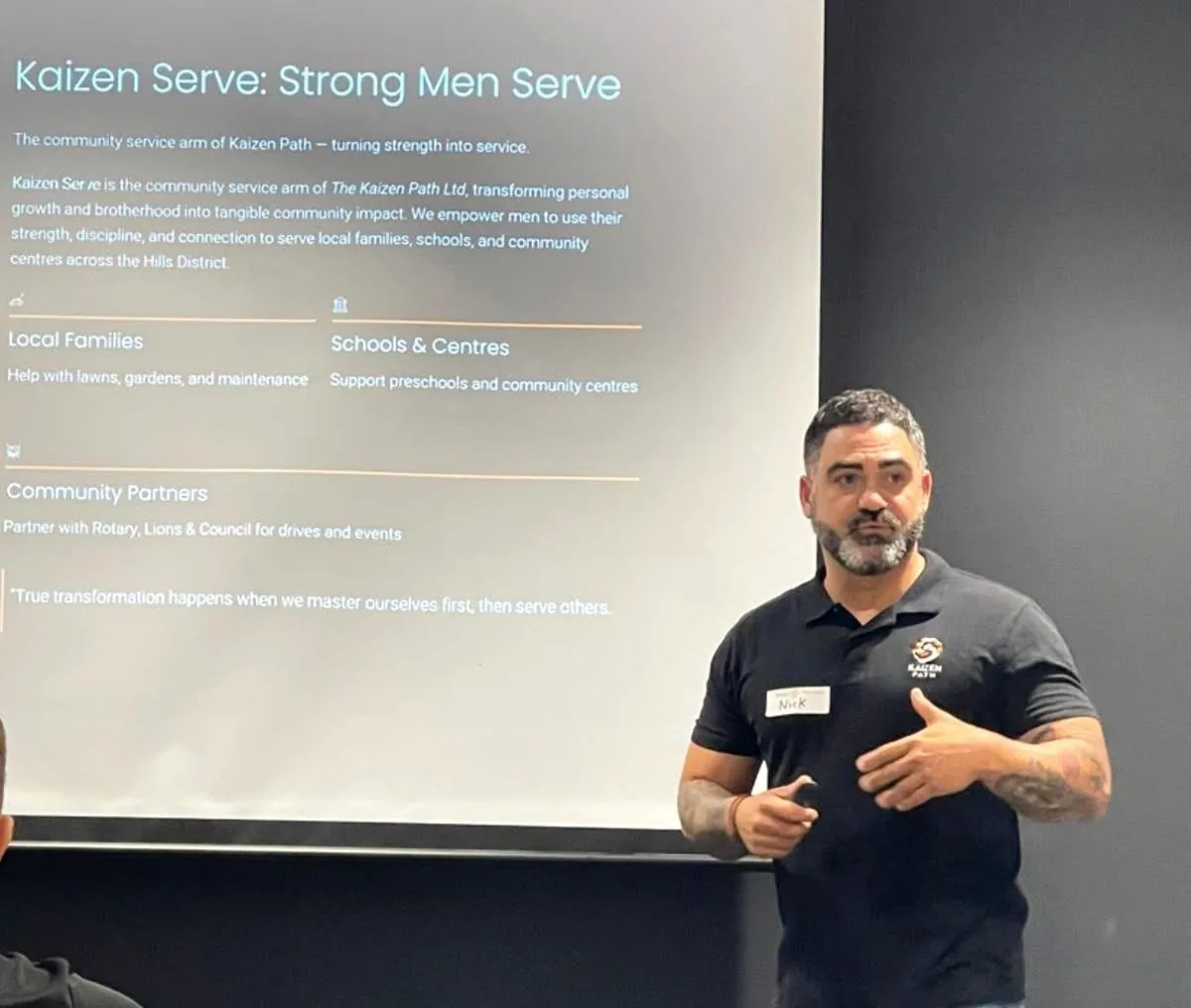
Wellbeing speaker · Sydney and NSW
Stress, sleep, connection and purpose, pitched at the room you've actually got. Workplaces, sites, schools, clubs and community groups across Sydney and NSW.

Why book Nick
The content shifts with the room. The starting point doesn't: give people something they can use tomorrow, and take the awkwardness out of talking about it.
Nick teaches health and physical education in NSW secondary schools, which means he has spent his career explaining sleep, stress, alcohol and mental health to people who didn't ask to be there. That turns out to be good training for a room of adults who would rather be somewhere else.
Outside teaching he founded and chairs Kaizen Path, a registered health promotion charity working on men's wellbeing and social connection in Sydney's Hills District. He runs gatherings, breathwork sessions and facilitated workshops most months.
Speaking topics
Everything comes with something practical attached. Sessions are tailored to the brief, the audience and the language of the room.
Why the body stays switched on long after the day ends, and how to bring it down deliberately.
Simple techniques that work in a car park or before a meeting. No mat required.
What moves the needle for shift workers, early starts and broken nights.
Why blokes in particular drift, what it costs them, and how groups rebuild it on purpose.
Ikigai as a working tool rather than a poster. For people mid-career and mid-life.
Kaizen: the one per cent shift, and why it outlasts the January overhaul every time. The idea the whole practice is built on.
Alcohol, scrolling, overwork. An honest look at the wind-down without the finger-wagging.
Noticing when a person is off, what to say first, and where the real help is.
What deliberate discomfort actually trains, and where the hype outruns the evidence.
Who Nick speaks to
Same evidence, different delivery. Nick matches the language, length and format to whoever is actually in the room.
Wellbeing days, leadership offsites, RUOK Day, or a regular slot in the calendar.
Toolbox talks at pre-start or smoko, pitched for the crew rather than the boardroom.
Staff professional learning, parent evenings, and senior student sessions.
Pre-season nights for players, coaches and committees.
Facilitated gatherings built around connection, not lectures.
Keynotes and breakout sessions on wellbeing, resilience and purpose.
Nobody changes their life because of a talk. They change it because of what they try in the week afterwards.
Formats
Every format ends with something people can try in the week afterwards. That is where the change happens.
One topic, done properly. Keynote, lunch session, toolbox talk, or a slot inside a bigger day.
Discussion, practical exercises and breathwork. People do things, not just hear them. Best under 30.
Purpose, discipline, resilience and legacy, built out over weeks. For groups that want depth, not a one-off.
Regular visits, a confidential check-in, and short modules in between so it doesn't stop when Nick leaves.
Try it now
This is the box breath Nick teaches in a car park or before a pre-start. Four in, four hold, four out, four hold. Press start, follow the ring, and see what a minute does to your shoulders.

"A powerful presentation with practical and well thought out strategies. Incredibly impressive."
Norwest Sunrise Rotary ClubInternational Men's Day breakfast
×
The kaizen idea
Improve by one per cent a day and the maths says you are thirty-seven37 times better in a year. That is the whole argument against the January overhaul, and it is what every session is built to leave behind.
Kaizen means one per cent. Boring on the day, undeniable by the year.
About Nick
I teach health and physical education in NSW secondary schools. Outside teaching I founded and chair Kaizen Path, a registered health promotion charity in Sydney's Hills District working on men's wellbeing and social connection. The work draws on Japanese and Greek ideas about incremental change, purpose and steadiness under pressure.
I'm not a counsellor and I don't pretend to be. My job is to make the topic ordinary.
Give people something practical, and be clear about where the real help sits. Every session names Lifeline, Beyond Blue and MATES in Construction, and every session ends with one thing to try that week.
The process
Most bookings are locked in after one call. Here's the whole thing.
Send the date, roughly how many people, and who they are. Crew, staff, students, committee. That's enough to start.
Ten minutes, usually. What's prompted this, what's already been tried, and what you'd want people saying on the drive home.
One page: format, topic, running time and cost. Nothing hidden, nothing bundled in that you didn't ask for.
I turn up early, work the room I'm given, and leave people with one thing to try. If it's a program, that's where the next session picks up.
Common questions
The things people usually ask on the first call. If yours isn't here, it's a two minute conversation.
Ask something elseFees depend on the format, the length of the session and the travel involved. A single talk sits well below a multi-session program. Send through the date, the format you have in mind and who is in the room, and Nick will come back with a figure in writing before anything is locked in. Sessions are invoiced under a sole trader ABN.
Yes. Nick is based in Sydney's Hills District and travels across New South Wales for talks, workshops and multi-session programs. Travel beyond greater Sydney is quoted separately and shown as a line item, never a surprise.
A talk suits any size room, from a pre-start crew to a conference audience. Workshops involve discussion and breathwork, so they work best under about 30 people so everyone can take part. If the group is bigger than that, the session is split or the format changes.
Yes, and it isn't optional. The evidence stays the same. The language and examples change depending on whether it is a boardroom, a smoko shed or a school hall. That is what the pre-session call is for.
No. Nick is a teacher and facilitator, not a counsellor or clinician. Sessions are educational and practical, and they are clear about where the real help sits, including Lifeline on 13 11 14 and Beyond Blue on 1300 22 4636.
One thing they can try that week, in plain language, that doesn't need equipment or an hour they haven't got. That is the whole design. Groups running a series also get a short follow-up between sessions.
Check a date
Two minutes. You'll get a format and a fee back, usually within a day or two.
Prefer to talk it through first? A quick call is often the fastest way to land on the right format.
Got a wellbeing day, pre-season night or toolbox talk coming up?
Send the date and the room. Nick will come back with a plan.